
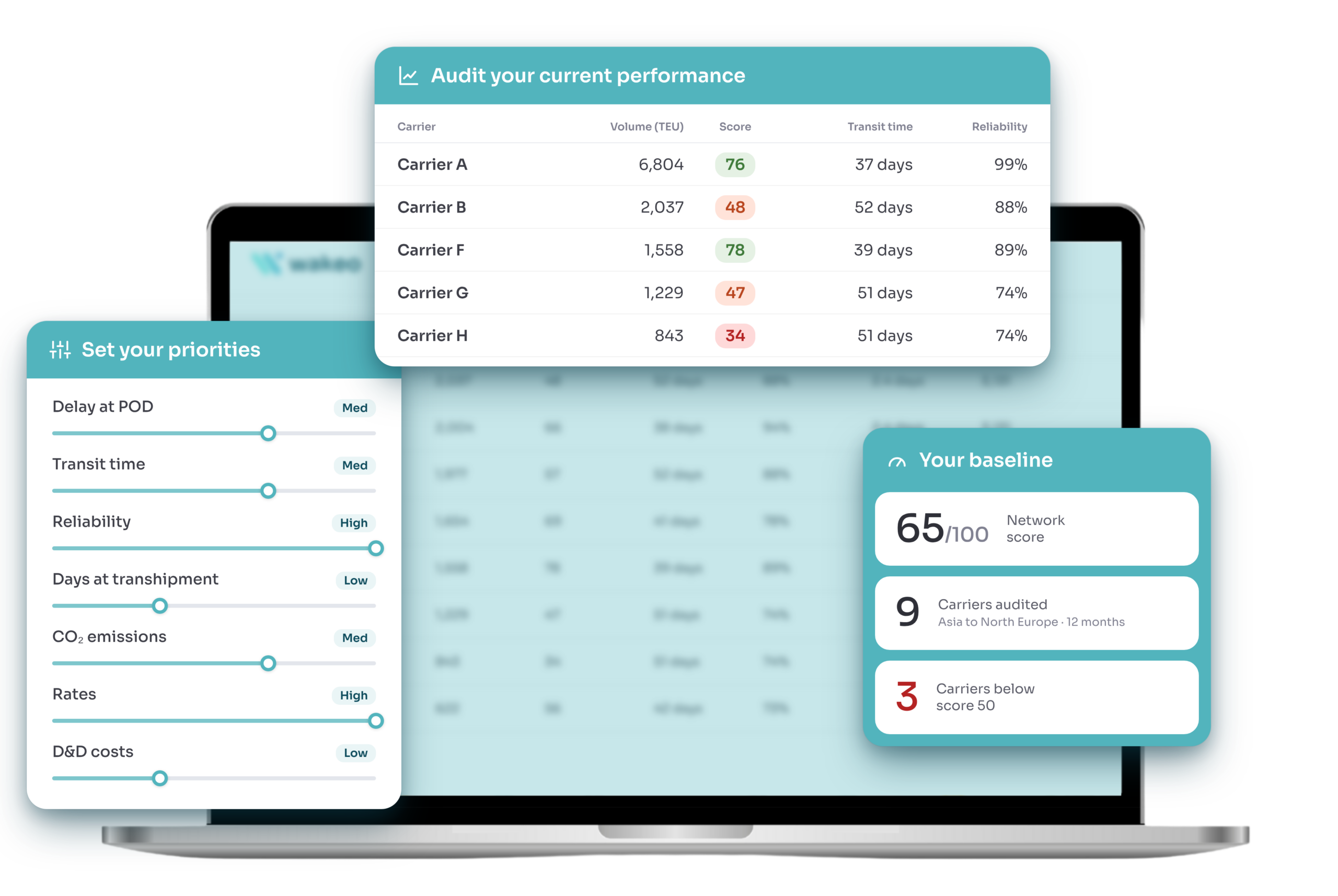
Wakeo announces the launch of Supply Chain Advisor. The new AI solution recommends the best routes and transport options for each flow, based on total cost and performance. It is available now to shippers and freight forwarders.
Most freight tenders are still decided on price. Yet a carrier that is cheaper on paper can cost more once delays, extra inventory, or demurrage and detention are added. With disruptions now reshaping trade lanes within months, companies need to know, before signing, which transport providers will actually deliver.
Supply Chain Advisor combines two sources of data. Wakeo’s real-time visibility shows how each transport provider performs on a company’s own flows, across sea, air, road, rail and parcel. Trusted Routes benchmarks the routes and transport options available on the market. Teams then set what matters most to them: cost, reliability, transit time, exposure to disruptions or CO2 emissions. The advisor scores their current transport plan, highlights the weakest routes and recommends better options.
Procurement teams optimize costs. Supply chain teams are judged on delivery. Both are right, yet they often pull in opposite directions, with no shared way to weigh price against performance. Supply Chain Advisor gives them a common language and a single platform. Both teams see the same data on cost, reliability, transit time and risk, and make the call together. It works alongside the tendering tools and spreadsheets teams already use.
“Ten years ago, we built Wakeo to give companies real-time visibility on their shipments, so they could react fast to disruptions, cut emergency costs and keep customers satisfied. But one question kept coming back: how can we do better next time?” says Julien Cote, CEO and Co-founder of Wakeo. “Supply Chain Advisor turns the data into decisions. A freight tender should not be a price negotiation alone. It should be the moment a company chooses the partners who will keep its promises to customers.”
“The advisor compares a company’s actual results with millions of historical shipments across the market,” says Loïc Marzin, Co-founder and CTO of Wakeo. “Our models predict how each route and transport option is likely to perform, then rank the options against the priorities each customer sets. The advisor recommends, and teams make the final decision, knowing the potential benefit of each choice before they commit.”
“Visibility is not the destination. It is the beginning of a better conversation,” says Bert Lemmens, Director EMEA Supply Chain and Leader of the SCM Global Office at Terumo. “For a global healthcare company, the value of transport data is not a dot on a map. It appears when the flow of data changes the flow of decisions, in purchasing, in routing and in sustainability. That is where supply chains are heading, and where the next gains will come from.”
“Resilient supply chains will be built on facts, not on assumptions about how carriers and routes perform,” says Julien Peignot, Intercontinental Logistics Control Tower Manager at Michelin. “Disruptions now redraw the map within months. The companies that keep their promise to customers will be the ones able to compare every option, weigh cost against reliability and emissions, and act before the problem reaches them. That is the direction our industry is already working on.”
Availability
Supply Chain Advisor is available now to shippers and freight forwarders.
More information at wakeo.co/platform/supply-chain-advisor or hello@wakeo.co.