
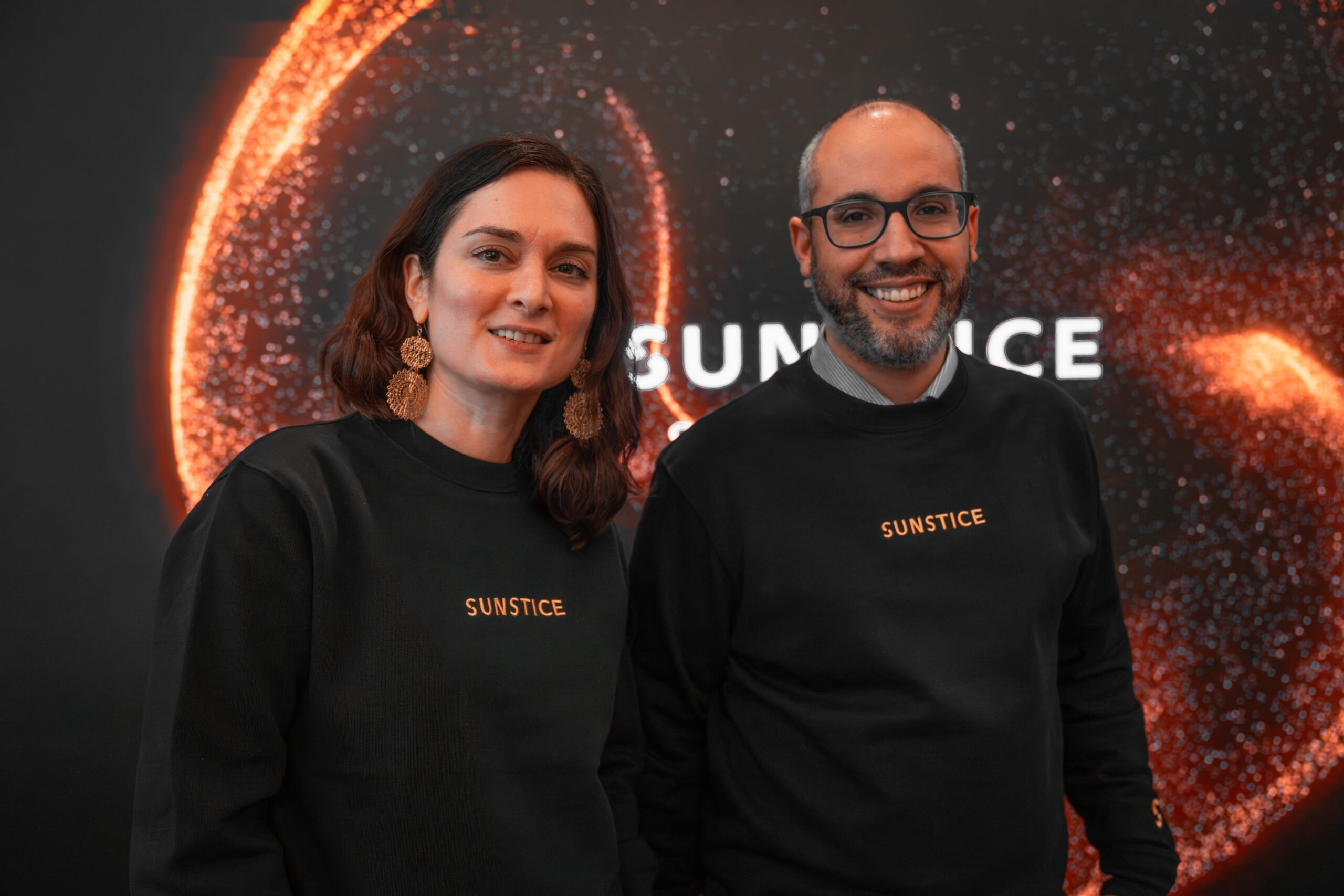
After more than three decades operating under the name FuturMaster, supply chain planning specialist Sunstice has unveiled a new identity that reflects a far deeper transformation than a simple rebrand. According to CEO Yacine Zeroual and Chief Marketing Officer Naïri Kurdoghlian, the new name captures a strategic repositioning shaped by systemic disruption, accelerated digitalisation and the company’s expanding technological and geographic footprint. “This was never about a cosmetic refresh,” Zeroual emphasises. “It is about aligning who we are with the reality our customers are facing today.”
From episodic shocks to systemic disruption
The immediate trigger for the rebranding was not aesthetics, but a reassessment of the environment in which global supply chains now operate. While volatility and uncertainty are not new phenomena, Zeroual and Kurdoghlian argue that the nature of disruption has fundamentally changed.
“What is new is not disruption itself, but the fact that disruptions are now instantly systemic,” says Zeroual. “Because the world is so physically and digitally connected, anything that happens in one place immediately cascades across global networks.”
Kurdoghlian adds that this shift forces organisations to rethink the role of planning altogether. “Our clients are no longer asking how to optimise in a relatively stable environment,” she explains. “Their real challenge is how to plan, adapt and perform under permanent uncertainty.”
This new reality has profound implications. Traditional planning models, designed for predictability, struggle to cope with continuous volatility. Planning, the Sunstice leadership argues, can no longer remain a background optimisation function. Instead, it must become a central driver of business performance, arbitrating trade offs between growth, margin and resilience on a daily basis.
Transformation accelerated by acquisition
The rebranding also follows a period of intense corporate and product transformation. In 2025, the company was acquired by Sagard Private Equity and expanded its portfolio through the acquisition of PlaniSense, adding advanced scheduling capabilities to its planning platform. At the same time, Sunstice continued to roll out innovations such as large scale forecasting, distributed data architectures and more agile optimisation capabilities.
“Our product has evolved very fast over the past few years,” Kurdoghlian says. “What we realised through client and employee surveys was that the product reality was moving faster than the brand.”
That growing gap created momentum for change. “There was a clear expectation,” she continues. “Clients and our own people felt that the company had outgrown its previous positioning. Combined with a better understanding of our customers’ operating reality, which made the timing unavoidable.”
The meaning behind the name Sunstice
The name Sunstice was chosen only after the strategic narrative had been fully defined. It combines “sun” with “solstice”, referencing the natural rhythm between the shortest and longest days of the year.
“The decision to change our name did not come first,” Kurdoghlian stresses. “We started with the vision and the positioning. Only then did we look for a name that could truly reflect that promise.”
For the leadership team, the solstice metaphor symbolises balance, rhythm and clarity in a world defined by extremes. More importantly, it reflects what Sunstice calls Structured Agility. “Agility without structure leads to chaos, and structure without agility leads to rigidity,” Zeroual explains. “Our ambition is to combine both.”
Introducing a new operating framework
At the core of the repositioning lies Sunstice’s new operating framework, which goes beyond tools or methodologies. Rather than starting with technology, the framework defines what organisations must be able to do in order to plan, adapt and perform under permanent uncertainty.
“Traditional planning models are reaching their limits,” says Zeroual. “Planning needs to shift from a background optimisation function to a central driver of business performance, where growth, margin and resilience are arbitrated every day under pressure.”
The framework spans supply chain planning and revenue growth management and brings together a set of interdependent capabilities. It enables organisations to anticipate change through scalable forecasting and early signals, to prepare for disruption by testing scenarios and trade offs in advance, and to continuously reorient networks, strategies and operating models as conditions evolve.
When disruptions do occur, the framework is designed to support fast, decisive action without sacrificing governance. At the same time, it allows companies to deliberately orchestrate growth and profitability, balancing service, margin and revenue in volatile environments. “The objective is not to choose between growth, resilience or profitability,” Zeroual notes. “It is to pursue all three at the same time.”
According to Kurdoghlian, intent always comes before tools. “The framework comes first. It is the direction,” she says. “Technology provides the means, and our solutions translate that into daily decisions. But it doesn’t start with technology – it starts with what needs to be enabled to adapt and perform under permanent uncertainty.”
Technology and the role of AI
While technology remains critical, Sunstice is explicit that it is an enabler rather than an end in itself. Artificial intelligence, advanced analytics and distributed data platforms support the operating framework, but do not define it.
“We do not believe you solve this equation by simply adding more technology,” Zeroual explains. “AI is important, but it is a means. What really matters is having a clear operating framework that technology can support.”
Many of Sunstice’s recent innovations, including forecasting at scale, rapid data integration and the operational capabilities brought by PlaniSense, were already aligned with this vision before it was formally articulated. Together, they strengthen the link between strategic foresight and operational responsiveness, helping organisations translate intent into execution.
Partners as force multipliers
Sunstice also places strong emphasis on its ecosystem of partners. Rather than pursuing scale for its own sake, the company focuses on working with organisations that bring deep supply chain expertise.
“Our customers do not buy software, they buy value,” says Zeroual. “Value depends on how well the framework, the expertise and the technology come together.”
One example is Sunstice’s collaboration with EY, which emerged through the acquisition of a specialist supply chain player. For Sunstice, such partnerships are about capability and standards. “We are demanding with our partners,” Zeroual adds. “But that is because we want to deliver consistent value to our clients.”
Markets, industries and global ambitions
Although Sunstice has strong roots in FMCG and luxury, with customers such as L’Oréal and Heineken, the leadership stresses that the new framework is not industry specific. Today, the company serves more than 650 customers worldwide across a wide range of sectors, with around 70 percent being long standing clients of more than ten years.
“We have evolved with our customers as their reality changed,” Kurdoghlian says. “That longevity is proof of both agility and structure.”
Manufacturing remains a key focus, while growing traction in automotive, aerospace and defence highlights the broader relevance of structured agility. Geographically, Europe remains a strong base, with increasing momentum in APAC through partner led models. North America is another strategic priority, marked by the opening of a new office in Austin, Texas.
A vision driven repositioning
For Zeroual, the rebrand to Sunstice is ultimately about reclaiming a vision driven approach in a market he believes has become overly dominated by scale and capital. “This market should be led by the quality of vision, not by the size of balance sheets,” he says.
With its new name, operating framework and ecosystem strategy, Sunstice is signalling not just who it is today, but how it believes supply chain planning must evolve in a world of permanent, systemic disruption.